アダム
for: Trb, Live electronics(MAX MSP)
duration: 10’
first performance: 2018.11.2 東京藝術大学音楽学部 第2ホール
(Trb.)安井貴大 Takahiro Yasui
score:
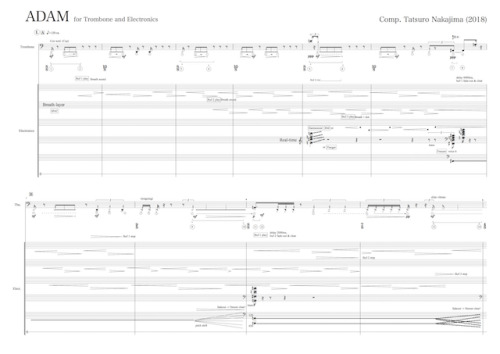
観衆は、演奏者が演じる人間の精神世界を、エレクトロニクスを介して追体験することとなる。製作にあたって、全ての素材を演奏中からリアルタイムに取り出すことを制約とした。これによって、演奏者は過去の演奏者自身を見つめ、同時に演奏者は過去の演奏者自身によって変化を及ぼされる現象が生じる。そして、演奏者はいわば「自己の内部を外部の世界として見つめる」状況となり、そこに観衆の錯覚が生じるのである。
この楽曲は、中心となる要素により、それぞれ5つのセクションに分割される。
第1セクションは、呼吸音がリアルタイムの録音とランダムなプレイバックによって次々と重ねられ、反復し、次第に呼吸が荒く、興奮していく様子が表される。
第2セクションはトロンボーンのグリッサンドにより動物的な鳴き声を模倣する。第1セクションでのブレス音の解析に基づき、ピッチに鳴き声のようなゆらぎが付けられる。
第3セクションは音程の不明瞭な低音の細かい動作により男性の声を模倣する。トロンボーンパートのリズムは実際の男性の会話を解析したものに基づく。このセクションは「生音とエレクトロニクスの対話」であり、仮想空間と現実の空間との音の交換、また相互のアナライズによる変調が行われる。
同一の譜面が繰り返される第4セクション、第5セクションにおいては、周期的な、無表情な呼吸の裏側にある精神世界を、エレクトロニクスが表出させる。第4セクションは強制的に音程をつけられたブレス音がリアルタイムに変調させられることで電子的な表情を見せる。第5セクションは、第4セクションのブレス音による周期的なリズムの反復の空間の中で、演奏者の呼吸音が水の音のような変調をさせられて聞こえる。
Audiences relives, through electronics, the mental world of a human. In the production, we were constrained to take all material out of the performance in real time. This creates a phenomenon in which the performer looks at himself in the past, while at the same time the performer is changed by himself in the past. The performer is, so to speak, “looking inside himself as the outside world,” and this is where the illusion of the audience arises.
The piece is divided into five sections, each with a central element.
In the first section, breathing sounds are layered one on top of the other by real-time recordings and random playback, repeating one after the other, representing increasingly labored and agitated breathing.
The second section mimics animalistic cries with trombone glissandos. Based on the analysis of the breath sounds in the first section, a squeal-like fluctuation is added to the pitch.
The third section imitates a male voice by means of fine movements of low notes of indistinct pitch. The rhythm of the trombone part is based on an analysis of actual male speech. This section is a “dialogue between live sound and electronics,” an exchange of sound between virtual and real space, as well as modulation through mutual analogies.
In the fourth and fifth sections, where the same musical score is repeated, the electronics bring to the surface the spiritual world behind the periodic, expressionless breathing.
In the fourth section, forced pitched breath sounds are modulated in real time to create an electronic expression.
In the fifth section, the sound of the performer’s breathing is modulated like the sound of water in the space of the repetition of the periodic rhythm of the breath sounds in the fourth section.