召喚 I
(2023)
本楽曲は次の3部から成り立つ。
1・・原始的なリズム(フルートから出される様々なノイズ音のサンプリング)の中で、フルート奏者は旋律を召喚するための「呪文」を演奏する。 「呪文」は、「モールス信号」に基づくリズムと、演奏者によってランダムに演奏される2音のセット(音程)である。さらに、リズムトラックはこの2音の音程に基づきリアルタイムに変化が加えられる。
フルート奏者には、第1部のこの機械的な「楽譜」のみが事前に与えられている。この楽譜も、ある文章を、モールス信号のリズムを元にした規則によって楽譜に変換しただけのものにすぎない。
2・・演奏者が「呪文」を終え一旦退場すると、旋律の召喚の準備が始まる。 フルートのサンプリング音によるリズムの氾濫の中で、演奏者の入力した呪文が、発展・展開し徐々に旋律を形作る。
3・・再入場したフルート奏者が、和音のヴェールの中で、ディスプレイ上に生成された新たな「旋律」を演奏する。続いて、最初に演奏された主題が、第1部の「呪文」に基づき、指定された時間内で様々に解体・変形して再提示される。
このように、無機的な暗号から召喚された旋律は、演奏者によって「有機的に」表現を吹き込まれ、未知の音楽を形作る。 第1部・第3部には音楽的な「発展」はなく、むしろ第2部においてこそ時間的な展開がなされる。本楽曲は、「聴く」というより「感じる」の方が適切かもしれない。
聴衆は、第2部においてその音楽の推移を楽しむことも、また一時退室することで、いわば「スキップ」することも可能なのである(ちなみに、第2部の持続時間は、休憩時間に応じて可変可能となっている)。
This piece consists of the following three parts:
1. In a space filled with primitive rhythms (sampling of various noise sounds produced by the flute), the flutist plays a “spell” to “summon melody. The ” spell “ is a rhythm based on ” Morse code “ and a set of two notes (pitches) played at random by the player. Furthermore, the rhythm track is varied in real-time based on the pitch of these two notes.
2. Once the performer finishes the “spell” and leaves the stage, preparations for the summoning of the “melody” begin. In the space of rhythmic inundation by the sampled sound of the flute, the incantation entered by the performer develops and evolves, gradually forming a melody.
3. The flutist re-enters the stage and plays the “melody” within a veil of chords. The theme played at the beginning is then deconstructed, transformed, and re-presented based on the “ spell ” of the first part. Thus, the melody summoned from the inorganic cipher is “organically” infused with expression by the performers to form the unknown music.
There is no musical “development” in the first and third sections; rather, it is in the second section that the music develops in time. This music may be more appropriate to “feel” than to “hear”.
The audience can enjoy the transition of the music in the second section, or they can “skip” it, so to speak, by leaving the room temporarily (incidentally, the duration of the second section can be varied according to the intermission time).
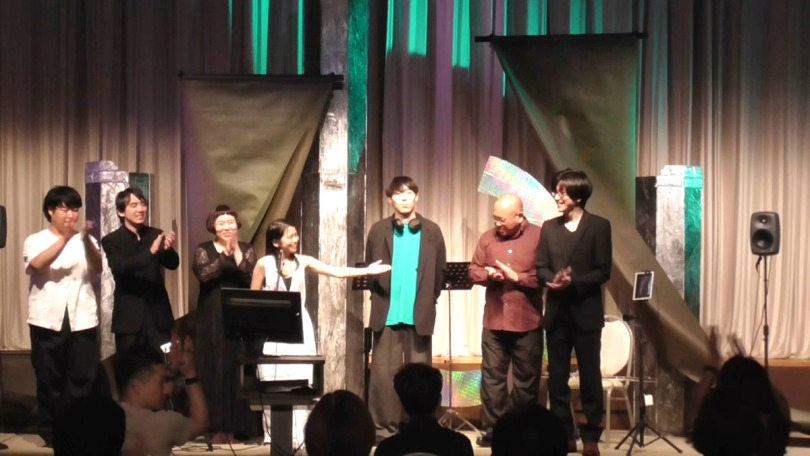
2023.08.19. New phase vol.1